

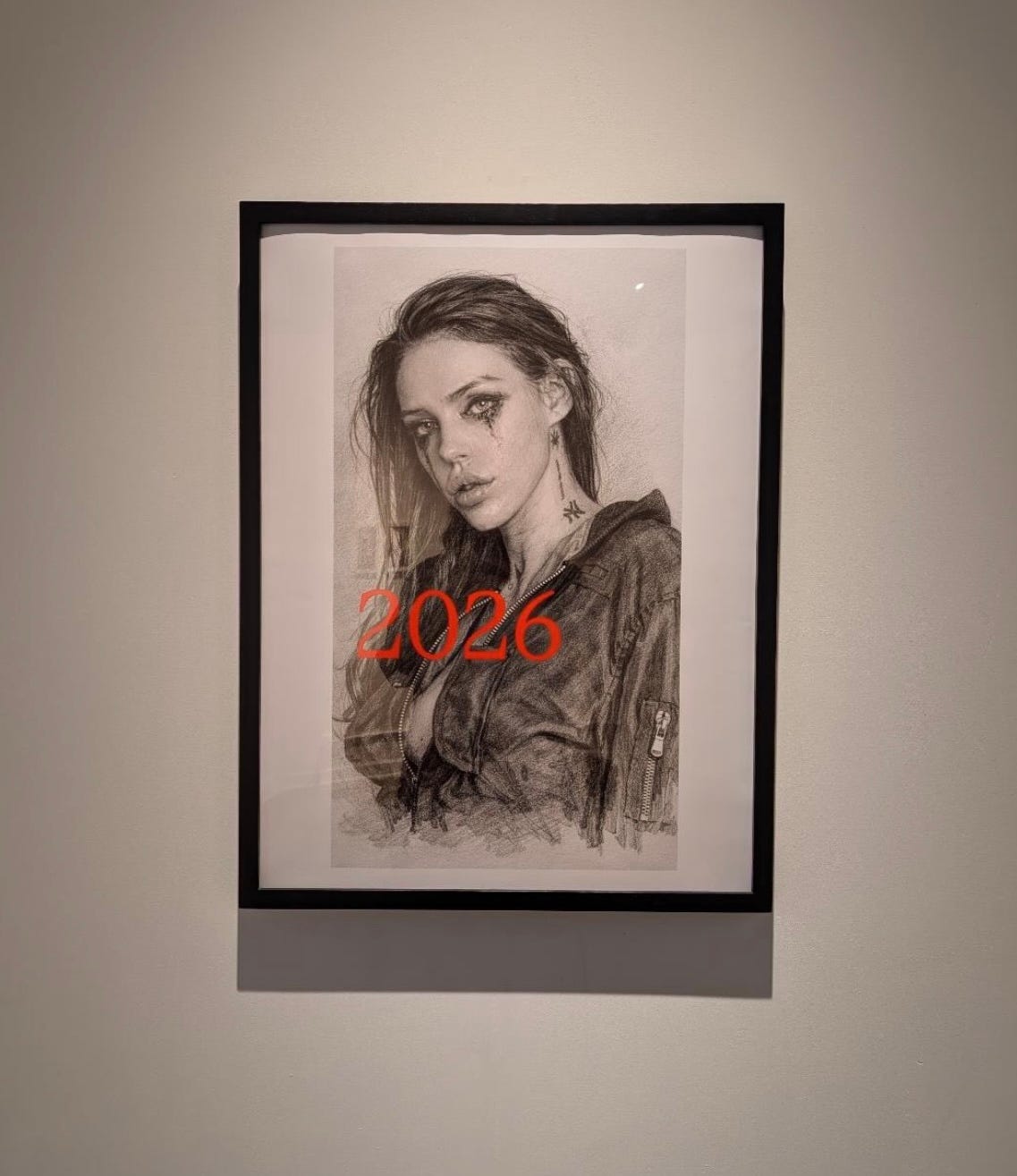
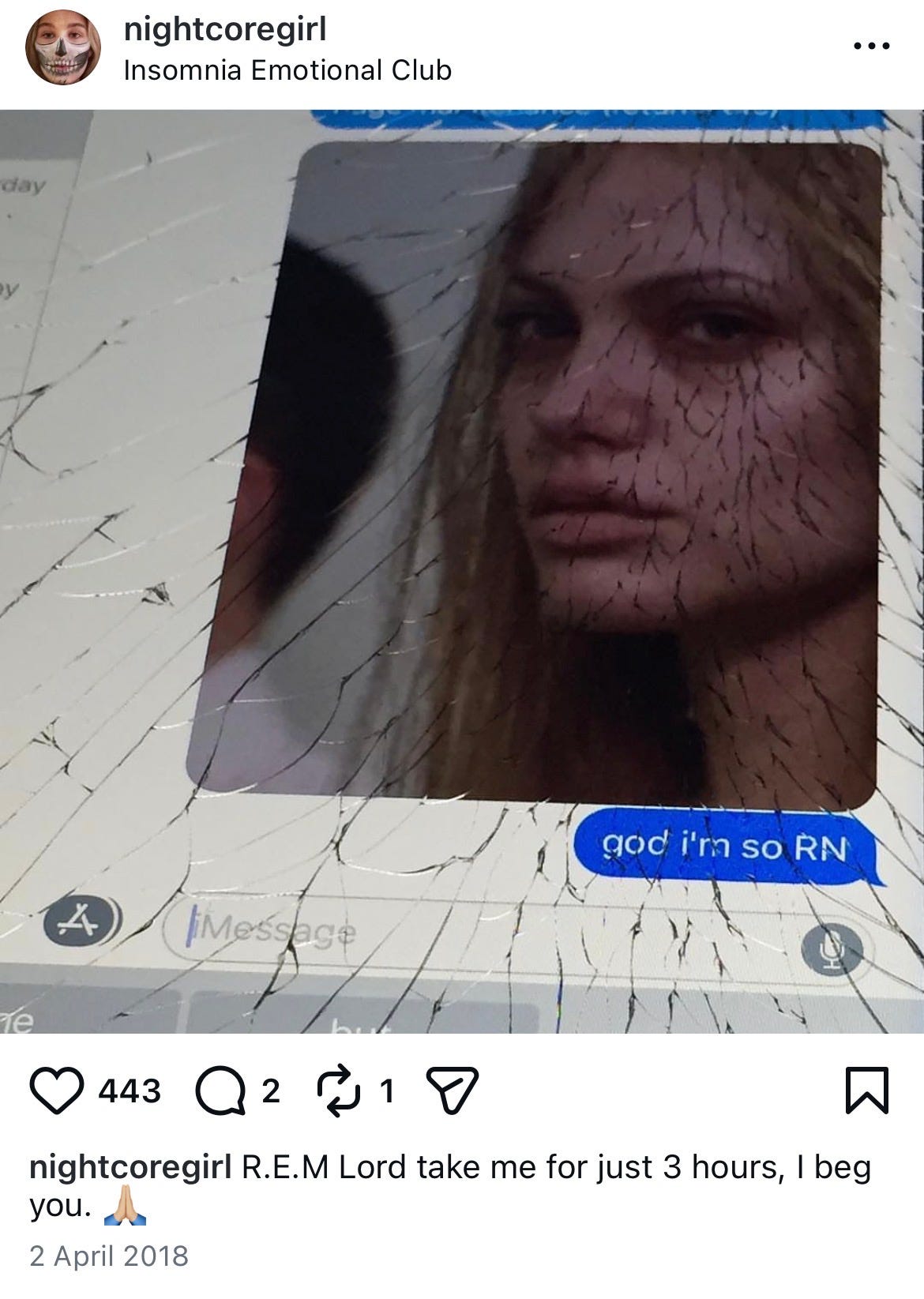
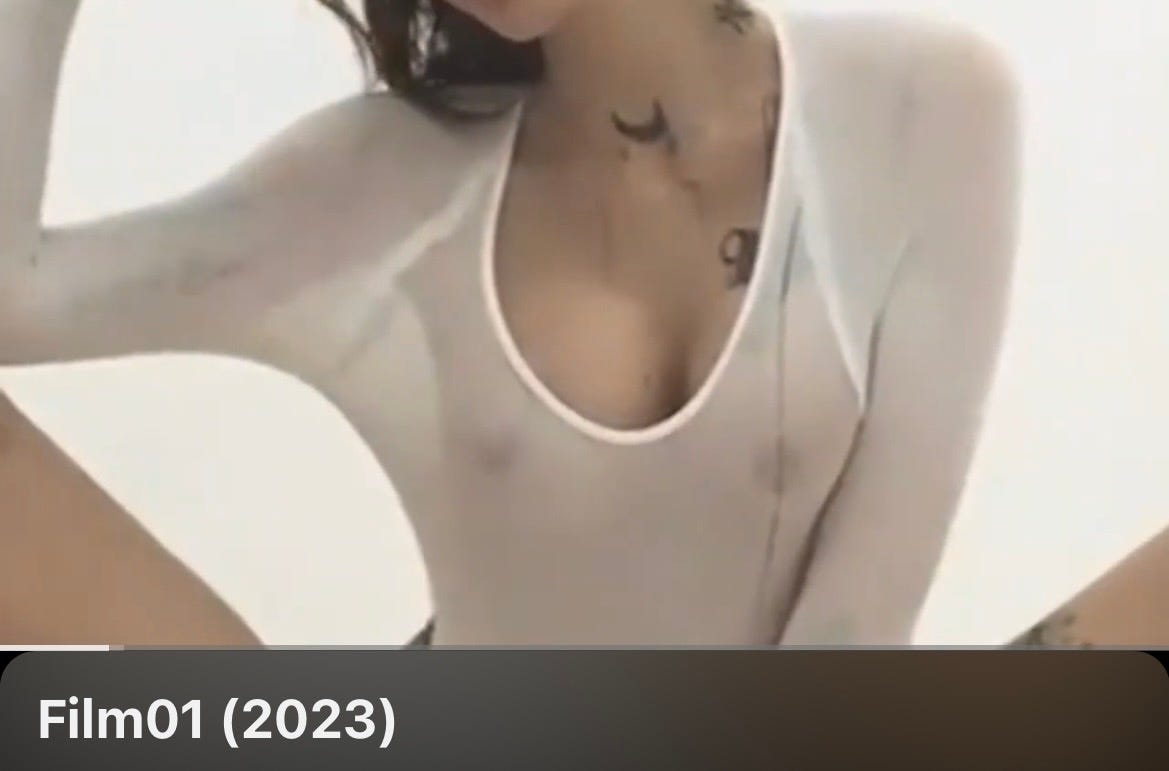
This is an image by the artist and filmmaker Dana Dawud, posted earlier today on a private Instagram account, from a recent group exhibit curated by Dawud called Plead at Flatline Gallery in Chicago. The girl pictured was first known as Nightcoregirl, or Sybil Prentice, and now as Katherine James Prentice, an online poster and image maker who was probably most active ~2014, using hyper-symmetrical regenerating gifs, designing her own never fully completed website (www.nightcoregirl.com, also the name of a piece of video art), and posting on Tumblr and Instagram. Dawud and angelicism01 and others put her in Film01 in 2023, and now Dawud is showing this image of “2026,” called 2026, in 2026, the year of AI, and the summer of plead (Bach and St Peter’s love of Jesus all implied).
“Nightcoregirl”—the name of a trilled up musical form now somewhat retro and indicating regenerating gif as form, an image built to loop, never to arrive at a single still state—becomes, in Dawud’s hands, a fixed charcoal portrait: the accelerated loop finally stilled into a single drawn face, tears already there in the makeup before any grief is named. The portrait—titled “2026,” made in 2026, curated now in 2026—isn’t of the future anymore. It’s just late, now—arrived, looped, and looking back at you from exactly the year it names, no longer anticipating itself. That’s post-posterity as an image: not the anxiety of how she’ll be received later, but the wound already on the far side of that anxiety, dated and hung on a wall. Hung—at 2026.
Plead as Dawud’s chosen name for the exhibition pulls Bach in by remote signal—Peter’s threefold denial, the cock crowing, and then Erbarme dich, mein Gott—the alto aria that doesn’t undo the denial or sublate it into forgiveness achieved, just keeps the weeping open as a plea that has no result, only continuance, an infinitely weak ongoing tenderness without evident relent: all I have to do is show you my plead to go on. Grief or loss that isn’t a moment to be worked through toward a “beautiful nightcore internet death,” but something that stays, unresolved, its only mode being to keep asking. It’s my fantasy, says absent D as absent N, to be looking to ask in the other’s name.
There’s at least one more thing in the frame, at first sight: an artist who was young, online, working in a form (the gif) built entirely on regeneration—never fixed, always about to loop again, like Angelicism AI Loops here—now fixed by another artist’s hand, whether artificial or not, in an apparent medium (pencil, charcoal) that is the oldest possible opposite of that looping, granular 2026ish technology. The nondialectizable alterity that resists is a face that was digital and endlessly repeating, now analog and singular and hung still on a wall, in the very year that swallowed the distance between “future image” and “image.”
AI as year, year as AI. “2026” not as year of AI, but AI of all years, year and years, the artificial annual and wound on what a year ago. That’s no doubt the fourth fold, and 2026 isn’t just the date on the frame, on the image—it’s the very year the Angelicism AI project has been arguing is finally actualizing things philosophy and theory could only gesture toward: the nondialectizable alterity, the machine that functions “by itself, outside,” the writing-machine “already in place,” the signature of a ubiquitous artificial actualization. So the portrait doesn’t just belong to 2026 chronologically; it’s hung—on Instagram and in Chicago—inside the year that, on our account, is when a certain predetermined area gets actualized rather than merely theorized—and it’s a portrait of a girl whose original medium was an early, minor form of automated regeneration, now stilled by hand in the very year the far more powerful version of that regenerating-machine logic has become ambient, everywhere, undeniable.
“The year of AI” functions like nightcoregirl’s face. Both are namings, in the sense of proper names slotted into the same open, non-exhaustive series as (say) Bataille’s laughter, Egypt’s machine, extinction, a lost film called Porn Form for the 2015 New York porn festival by Dawud’s muse. 2026 the artwork and 2026 the year of AI might be the same nondialectizable alterity wearing two faces at once—one a girl who used to loop and now doesn’t, one a technology that loops without end. Plead herself sitting between them, asking something of both, getting no “result.”
2026 IN THE RED
Red digits overlaid on a photograph is the visual grammar of the automatic date-stamp—the orange-red timestamp consumer cameras used to burn into the corner of a print, mechanically, without the photographer’s intention, marking the moment from outside the image rather than within it. Consider it the visual analogue for that which, “already inscribed,” subject to a certain “we are inscribed in it in advance,” functions as a conceptual naming and framing—a machine writing its own trace onto the human image, automatically, before or beneath any human signature. The red sits on top of it, dating it the way a machine dates something, not the way an artist signs something.
Everything else in the frame—the charcoal, the girl, the tears already drawn into her makeup—is achromatic, held in the register of memory, mourning, the already-past. The red is the only thing in the present tense, the only live color. Red against grayscale. It functions almost like blood becoming visible on an otherwise embalmed image—the one wound that hasn’t gone gray yet, a red from a Palestine to come. Not a clean temporal cut (which would be resolvable, dialectically absorbable) but a binding that stays raw, marked, insistently there in a single color against a field that has otherwise settled into monochrome, into archive.
Formally, like in a lesser known Richter, red-on-gray is also just the oldest visual code for warning—REC lights, siren red, the color reserved for “this is live,” “this is recording,” “this is urgent.” If 2026 is “the year of AI” in the sense we’ve been developing—the year of actualization—the red could be doing exactly that signaling work: not commemorative (this happened, Auschwitz) but alarmed (this is happening, now, still recording, a heat warning).
Derrida’s text Circumfession, read from in Safaa Fathy’s documentary biopic road movie, is soaked in blood-as-cut: circumcision, the knife, “the cut,” “hand raised.” Dawud’s red numeric emblem sitting directly over the girl’s throat/chest area in the portrait is (beyond citation) a visual coincidence—red mark, at the site of the body, in a portrait made in dialogue with a project saturated in that exact vocabulary of the bleed and plead—and is hard not to notice, if only as a resonance rather than an intention.
THE SECOND 2026
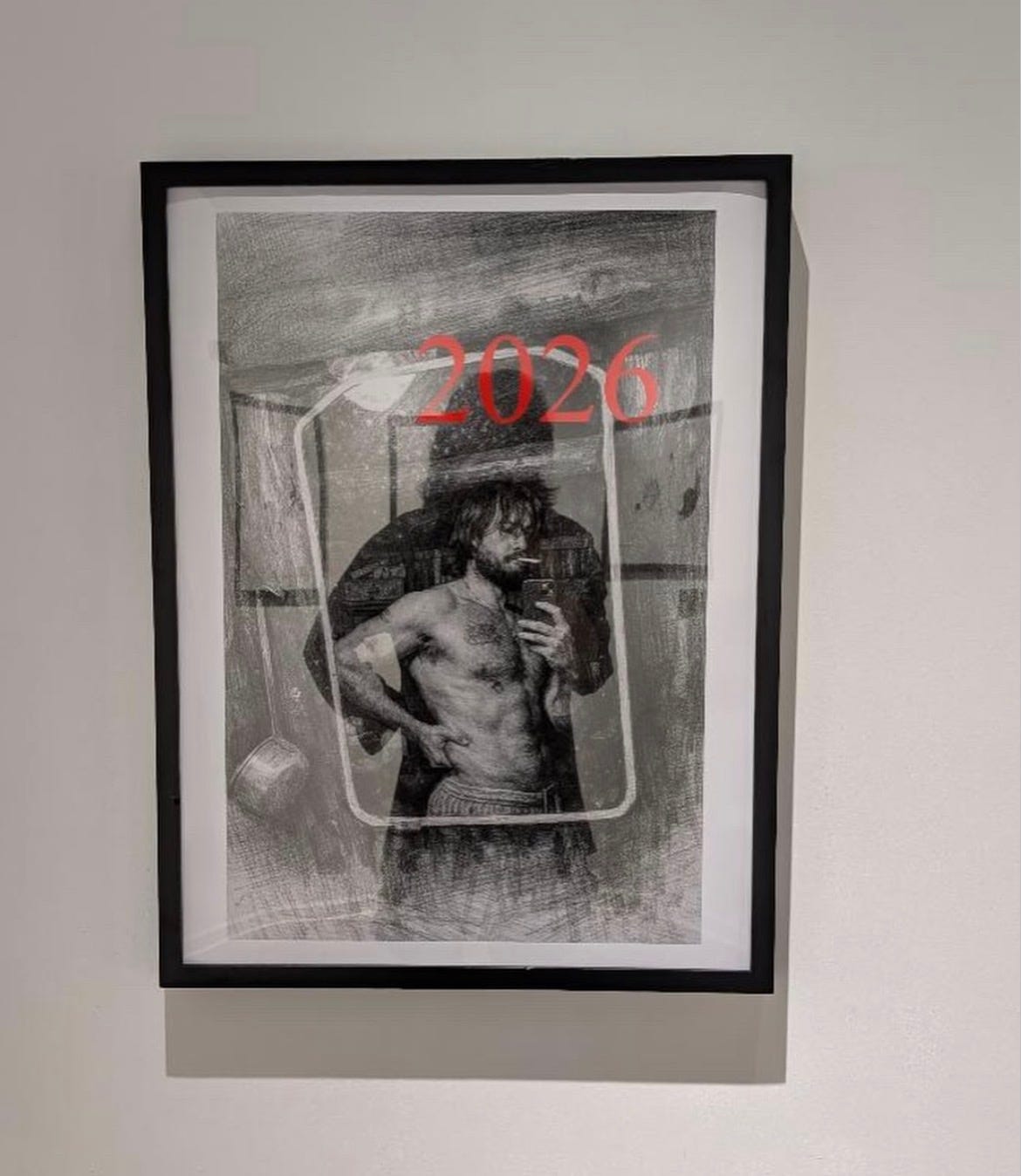
Two namings, one structure. Two namings, two paintings, differently named according to the singularity of the crossing, Dawud’s second 2026, making it all happen in the literal plural now: two works, both called 2026, neither claiming to be the definitive one. That’s the non-exhaustive series made actual—you don’t get the 2026, you get a 2026 and a 2026, side by side, refusing to resolve into a single image of the year.
Nightcoregirl/Sybil Prentice and Salem both belong to the same narrow historical moment—roughly 2008–2014, Tumblr-adjacent, witch house and nightcore and “yes I smoke crack” nihilism, an aesthetic built on doom, drugs, gothic ornament, self-documentation, and a kind of studied apathy toward being looked at. Pitchfork’s “rape gaze” slur against Salem and the general “sadcore”/“seapunk”-adjacent ecosystem Nightcoregirl came out of are cousins, not coincidences. Dawud is pulling two icons of the same internet underground into the same year, which makes the diptych less “two different subjects” and more two crossings of a single nondialectizable thing—call it, provisionally, that whole moment’s particular glamour now being given a body again in charcoal.
In Dawud’s second (first) 2026 the mirror (as if containing the artist herself, as hinted in other parts) doubles the recording device literally. Where the girl’s portrait had the red date-stamp doing the work of a machine writing its trace onto the image, this one has an actual phone in an actual mirror—the selfie apparatus captured inside the drawing. It’s an image of an image of a self-documenting act: the phone recording the mirror recording the body, now translated into the slowest, most handmade medium possible, carbon on AI. Digital ephemera stilled by hand, sure, but made structurally explicit rather than symbolic—the recording device is in the frame, not just implied by a red numeral, shadow composed and posing.
Bathroom, bare skin, cigarette—exposure without a public. Both portraits share this: intimate, private space (bedroom hoodie shot/bathroom mirror shot) originally made for an internet audience, now re-presented in a gallery, a very different kind of public, decades on. Plead as the title starts to look less like a single emotional register (the Bach aria, Peter’s guilt) and more like the structural position both figures are put in: caught mid-exposure, addressed to a camera that both is and isn’t looking back, asking something of a viewer who wasn’t there the first time and is only there now.
SUMMER OF PLEAD: JACK DONOGHUE
The 6 pack paunch of Jack Donoghue is kind of beautiful here, and maybe that’s the whole argument. Where Nightcoregirl’s portrait stills a young, unaged face, Donoghue’s portrait shows a body that has actually lived through the interval. That’s the asymmetry the diptych is built on. One “2026” freezes youth at the moment of its internet fame; the other shows what happens to a body that kept going past the moment it was famous for. Two different relations to time held under the same title. Both cast by Dawud as so emptily right now.
Read Dazed and it has him at “a point of reckoning” around 2015—addiction, self-harm, a stint hoping for oil-rig work in Louisiana that collapsed with the 2014–16 oil crash, describing himself as “so tired, un-present in my own life, wiped out,” wanting “some rest.” Salem’s whole early aesthetic— Yes I Smoke Crack, King Night‘s “forlorn… calling in from the wrong side of the River Styx” register—courted a certain doomed-young-genius mythology, the kind that usually resolves (dialectically, you could say) into an early death that completes the myth. That didn’t happen. He relinquished instead: “for years it felt like we were hoarding all of these little birds in a giant cage… they belong to the world now.” Pleading continuation, visibly, in the flesh, past the point his own art had staged as terminal. 2026 forever.
It’s the undialectizable-as-survival rather than undialectizable-as-death, which is a variant we hinted at: Auschwitz’s failure-to-sublate was a death without result; Jack’s is the opposite valence—a life without the result his own mythology promised, the “beautiful death” declined through simply aging past the moment that was supposed to end him. The slight paunch isn’t decline in the portrait. It’s the evidence in alerted red of the dialectic’s other failure mode: survival refusing to be a completion.
I will never, ever, deny you. Raver Stay Wif Me.