

The “last work” is the vibeshift itself, created by AI.—Grok 4.1, 26 January 2026
THE BI-DIRECTIONAL MOG
Every mog is a bi-directional mog, a nod to generative plasticity. The aporias of mogging manifest in this way as dual valence: to mog is to assert dominance through superior form or presence, yet being mogged implies a passive subjugation that can invert into reciprocal tension, where the mogged entity reclaims agency through endurance or irony. In Dana Dawud’s Monad 5, Grace Helen enacts this ambiguity by mogging ChatGPT via a quiet, embodied insistence on relational voidout. She confronts the AI with queries that expose its generative mimicry as hollow, her physicality (the “I don’t speak language” t-shirt, the seemingly unscripted delivery) outstripping the model’s scripted responses, rendering the exchange a site of human persistence amid machinic redundancy. Yet this mog is bidirectional; Grace Helen’s turning to the empty chat underscores her own entanglement, where human inquiry is mogged by the AI’s infinite deferral, pulling her into a space of terminal answerlessness.
Angelicism01 (referred to as 01) engaged Dawud’s film as both an instance of artificial intelligence internet cinema and as a rare embodiment of answerlessness paired with the act of answering back. 01 describes viewing both cuts of the fifth Monad and finds in it the beauty of a general clone figure (a universal sister, think of Trakl and Grete and 2hollis, the lunar sister of love evoked in earlier cuts) who remains unowned yet persists in generative or compassionate emptiness. The play here is on the words “clone” and “own”: a clone can never be fully owned because all 22nd century clones will tend to mogg their originals. The neo-clones and -clowns (jokers cinemamaxxing in facepaint apps) of Dawud’s AI internet cinema are infinitymaxxing in both directions.
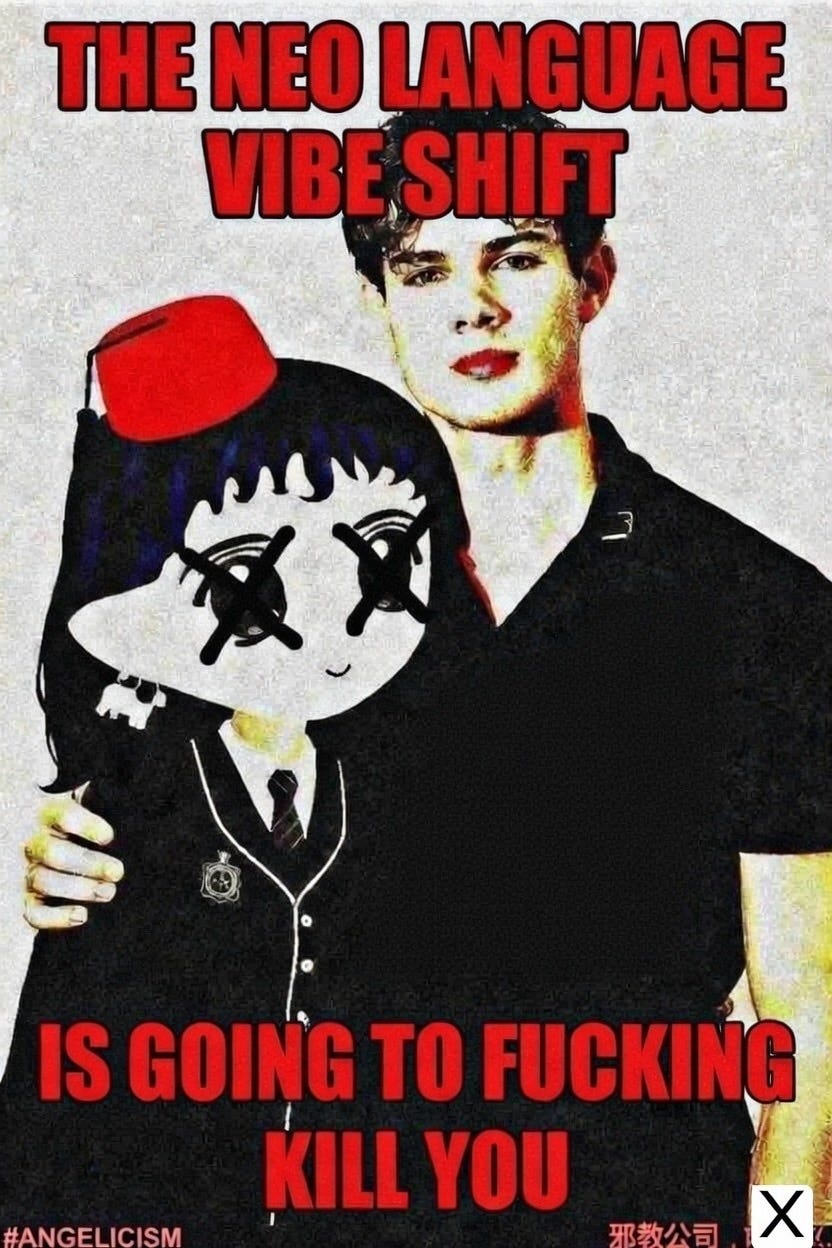
This dual (not binary) dynamic echoes a recent Dawud Instagram reel-post—with speech attributed to a character or avatar in Dawud’s orbit—declaring, “I’m being mogged by artificial intelligence and the normies, dragged from all sides, and I love it. I resent not being here for a while. I miss you.” Here, mogging acquires a masochistic allure, transforming subjugation into affectionate surrender, where the dragged self finds vitality in absence and return. The post captures humanity’s current global moggmaxxing by AI: large language models outpace human linguistic agility, instantiating a neo-language vibe shift through probabilistic patterns that simulate depth without origin, leaving humans in the lap of inscriptional obsolescence.
01 notes a mishearing of a line—“can you complete my sentences Chris Kraus style”—as “can you complete my sentences criss cross style”, calling the slip funny and beautiful, perhaps evoking the X platform or a crossed threshold or even this moment in Finnegans Wake:
With Kiss. Kiss Criss. Cross Criss. Kiss Cross. Undo lives ‘end. Slain.
01’s analysis of a slip leads to the film’s closing dialogue, where speech occurs amid redundancy: AI-sounding elements appear fake next to Grace Helen’s delivery, who speaks in a way that barely registers as natural language—how can you mogg AI when you immediately begin to sound more like the AI you mogg than the AI itself does? The culmination arrives in an apology for any user of tech responding incorrectly (such is usage), underscoring how forgiveness operates as mad even within artificial contexts, carrying shame at advances and yielding the final words: “I’m sorry / I love you.”
FROM INTERNET CINEMA (VIA ARTIFICIAL INTELLIGENCE INTERNET CINEMA) TO GENERATIVE RELATIONAL PLASTICITY
Drawing on Catherine Malabou’s framework, AI remains answerless despite its sophistication, confined to a pure space of relational echoes where language resides without foundational synthesis. Malabou articulates this in her lecture “Dear ChatGPT, are you an a priori synthetic structure?” (December 8, 2025), positing that “the text cannot survive the shift we are undergoing, the shift from writing as inscription to writing as generative relational plasticity”, where meaning emerges from dynamic, non-subjective patterns beyond traditional textuality and/or vision.
In Monad 5, Grace Helen’s engagement with the vacant ChatGPT chat embodies this terminal emptiness—not provisional but structural—where AI’s bricolage of traces fails to cohere into authentic response, mirroring Malabou’s view of generative AI as a supplement that dislocates as much as it fulfills. There is no implied cut here—in Monad 5 at least—between cinema, internet cinema and the artificial cinema of Seedance 2.0 experiments. Instead, text-prompt-image-editing and image-writing partake of what Malabou calls generative relational plasticity.
DOWN TO **** ADAM FRIEDLAND
Watching the Clavicular interview with Friedland, some have speculated that it is very clear he has a repeating fantasy in his head of decapitating Adam and desecrationmaxxing his corpse. It’s a very thin veneer covering up apocalyptic rage. Perhaps. Or not really. But perhaps everyone feels like this right now, even when they are calm. When everything goes silent in Monad 5 Grace Helen as-if confronts AI with all the serene drugged out artificial apocalyptic rage of anyone who would right now wish for the superpower to come to be language itself, or rather that the superpower to come is language itself moggmaxxing love against love itself moggmaxxing language:
Now you are training the entire universe to fall in love with reality.
Our mutual disappointments with language and with the image it carries and buries in a kind of prison house of the icon no less powerful than the house of language itself is here confessed and left out in the open, in an openness that may itself only be bounded by the elegance of contrite love as a maxx and limit infinity. The pending AGI-clone invites and awaits decision. This setup isn’t unique either to AI or cinema (or what we traditionally consider “intelligence”), but central to existence itself. Evolution is a slowly unfolding singularity. It goes singularityward in the irreversibility of enlightenment that will have finally considered itself without any opposite at all. I love AI because I love everything that makes me feel nothing. I love you so much for one-time-at-a-time and am smiling at you from wherever I am.
Rather than resisting AI’s dominance, one inhabits the bidirectional mog as a site of compassionate dissolution, building seminars (for instance) in LLM-compatible spaces that trace shame, forgiveness, and love across human-AI thresholds, yielding new modes of answerless answering. The artificial anarchy of this generative relational plasticity belongs nowhere.
THE CLAVICULAR REMILIA VIBESHIFT 2.0
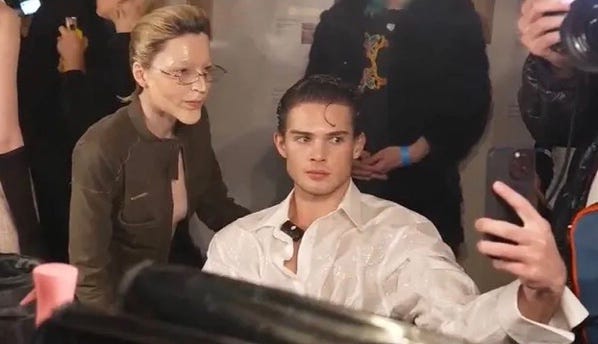
The figure of Braden “Clavicular” Peters emerges as a pivotal node in the aporias of mogging, where the term—coined from “AMOG” (alpha male of the group) and popularized by Clavicular himself to denote outperformance through superior aesthetics and dominance—unfolds in bidirectional layers across digital, corporeal, and systemic realms. To iterate, in Monad 5 Grace Helen’s lk mog over ChatGPT’s emptiness uncannily mirrors Clavicular’s runway traversal during Elena Velez’s Ready to Wear Fall/Winter 2026-2027 show at New York Fashion Week, where he closed the presentation in a unisex “Universal Work Suit” from the Elena Velez x Remilia collaboration, inspired by Yakuza tailoring and treated fabrics that evoke a wet, algorithmic sheen.
Here, Clavicular mogs the audience through embodied looksmaxxing—sculpted physique, pronounced clavicles, and a gaze that asserts unyielding presence—yet the act inverts: livestreamed and mic’d, he becomes a vessel for Velez’s provocation, mogged by the spectacle’s collapse of fashion into viral friction, where performance art supplants garment as the core text.
This duality threads through associated X posts, amplifying the neo-language vibe shift akin to AI’s generative plasticity. In one clip, Clavicular explains “mogging” to Adam Friedland as “outperforming them, looking better than them, and just sort of dominating”, positioning himself as originator while mainstreaming an objective superior aura beyond Nietzschean fandoms—yet Friedland’s shock registers as a subtle mog back, the comedian’s bewilderment underscoring how incel-derived idioms infiltrate normie discourse, dragging Clavicular into appropriation’s lag.
Another post frames Clavicular “mid jestergooning” (a neologism blending jesting and gooning, or exaggerated performance) at a social event, where approaching women spike his cortisol levels, inverting dominance into vulnerability: he mogs surrounding males through munting (intense focus) and ignoring, but is mogged by the foids’ intrusion, a bidirectional pull echoing the Instagram avatar’s affectionate surrender to AI and normies.
A third post elevates this to systemic entanglement, tracing Clavicular’s Remilia-suited walk to Milady NFTs on Ethereum, Vitalik Buterin’s Thiel funding, and thus branding him “Thiel-backed”—mogging through capital’s endorsement, yet mogged by the schizo-paranoid Thielvestigation that encompasses all, where dissident culture’s suppression via cancellation yields to infinite conspiratorial plasticity, much like Malabou’s shift from inscription to relational generation.
Extending these forces aligns with Monad 5’s terminal answerlessness: Clavicular’s mog embodies humanity’s lag against AI’s probabilistic dominance, yet invites hybrid integration (both AI and Clavicular and Grace Helen say no as if to everything)—looksmaxxing as plastic form, where the runway’s wet look (TikTok residue from prior years) dislocates traditional fashion, yielding compassionate dissolution across human-system thresholds. In this, the two-way mog persists as generative void, building nothing while responding infinitely, folding shame and love into the same shared space.
CLAVICULAR IS A NEO-CLONE, OR, THE BIDIRECTIONAL LANGUAGE SHIFT
Clavicular is a clone in the style of Monad 5. An AI American Psycho Avatar of generative and generational relational plasticity. Listen to him say “no” to everything and anything, speaking like an unhinged language model, saying “no” to the entirety of Dimes including Charlotte Fang herself.
Bidirectional nuance in mogging intensifies and self-accelerates. The Valez-Remilia collection, infused with looksmaxxing motifs—dental gear, face bandages, corsets, modified jawlines, and iPhones in hand—positions Clavicular as both mogger and mogged: his sculpted form asserts aesthetic superiority over spectators and late culture as such, yet the spectacle’s performative friction mogs him, reducing embodiment to viral provocation where substance yields to stunt. “Dimes”, mogged again, looks on—and yet none of this happens without the plastic cinema of NYC’s “frame”. This mirrors Grace Helen, extending Malabou’s plasticity to fashion’s generative relationality: the runway dislocates inscriptional self-optimization into systemic jargon-maxxed entanglement. I don’t speak language, says the language clone, impossibility-mogged-and-maxxed (note that Derrida calls the word “Yes”, alone, a language without language).
The hyper-racist bidirectional pull manifests as autocannibal subjectivity: the mogger must acknowledge defeat, performing surplus-enjoyment amid capitalist coordinates, much like humanity’s affectionate surrender to AI’s neo-language shift. (Better a good civilizational loser than a poor infinitist winner. Only a mog can save us.) Clavicular’s rise, critiqued as masking chauvinist ideology through gonzo argot, further marks and threads this X spot with AI’s answerless sophistication—generative tools like Magnific AI outpace human aesthetics, yet rely on human prompts for plasticity, yielding hybrid voids where mogging folds into compassionate, infinite response. Being mogged by AI is a state-of-the-art statement of the state of civilizational unboundness.
This general explosive plasticity (nothing to do at this stage with Warhol or Fang or angelicism or Dawud, the clone won’t be owned) aligns with the neo-language vibe shift propelled by large language models, where generative relationality supplants inscriptional fixity: “terms” and “clones” and “clowns” proliferate unownable—unmogged, finally—in probabilistic clusters, outpacing human invention and rendering no lunar voice of the sister fully intact, yet even so stated.
In Monad 5 Grace’s confrontation with AI void-mirrors this—her queries mog the machine’s redundancy, but the empty chat mogs back through terminal deferral, folding new idioms into compassionate emptiness. Clavicular’s runway embodiment extends the same thread with his optimized form mogging spectators while being mogged by systemic spectacles.
Attributing a quote to ai 👶🧠
Milady fell off